
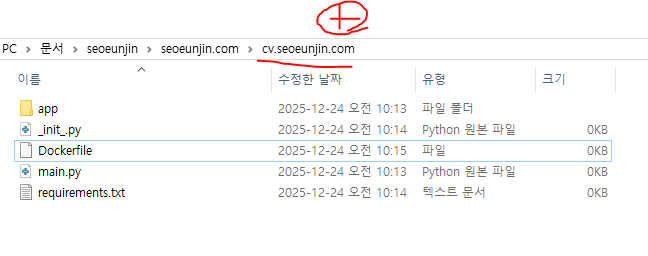
여기서만 커서 열기
251224 손글씨 MNIST 를 파이토치로 구현하기.
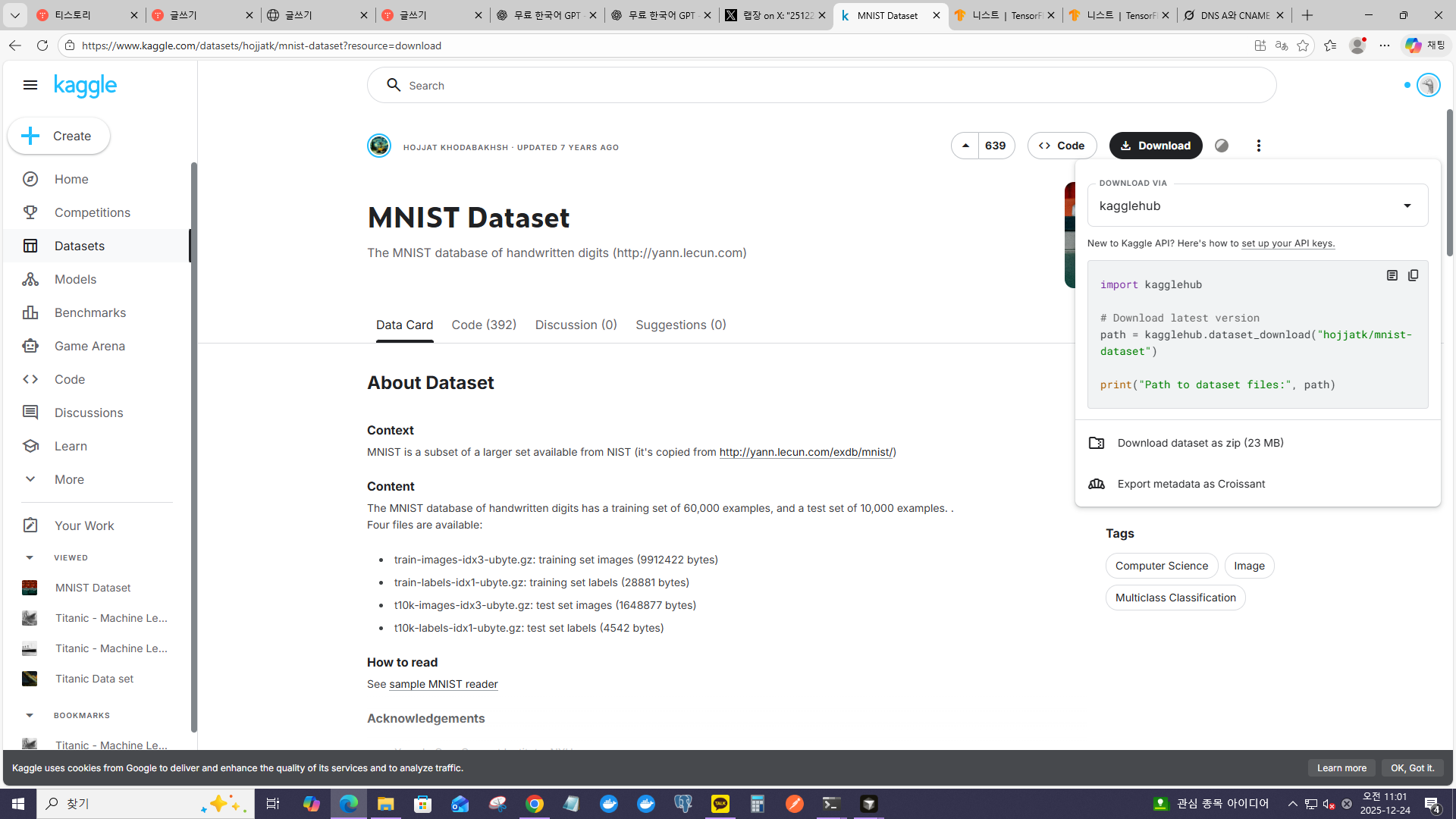
여기서 알집으로 다운받기
MNIST Dataset
The MNIST database of handwritten digits (http://yann.lecun.com)
www.kaggle.com
니스트 | TensorFlow Datasets
이 페이지는 Cloud Translation API를 통해 번역되었습니다. 니스트 컬렉션을 사용해 정리하기 내 환경설정을 기준으로 콘텐츠를 저장하고 분류하세요. 손으로 쓴 숫자의 MNIST 데이터베이스입니다. 나
www.tensorflow.org
텐서플로 참조 링크

알집 받은 것 중에 이렇게 하기

우선 공 파일과 폴더 만들기
여기에
# 머신러닝 학습의 Hello World 와 같은 MNIST(손글씨 숫자 인식) 문제를 신경망으로 풀어봅니다. import tensorflow as tf from tensorflow.examples.tutorials.mnist import input_data # 텐서플로우에 기본 내장된 mnist 모듈을 이용하여 데이터를 로드합니다. # 지정한 폴더에 MNIST 데이터가 없는 경우 자동으로 데이터를 다운로드합니다. # one_hot 옵션은 레이블을 동물 분류 예제에서 보았던 one_hot 방식의 데이터로 만들어줍니다. mnist = input_data.read_data_sets("./mnist/data/", one_hot=True) # MNIST 데이터를 다운로드 한다. from tensorflow.examples.tutorials.mnist import input_data mnist = input_data.read_data_sets("MNIST_data/", one_hot=True) ######### # 신경망 모델 구성 ###### # 입력 값의 차원은 [배치크기, 특성값] 으로 되어 있습니다. # 손글씨 이미지는 28x28 픽셀로 이루어져 있고, 이를 784개의 특성값으로 정합니다. X = tf.placeholder(tf.float32, [None, 784]) # 결과는 0~9 의 10 가지 분류를 가집니다. Y = tf.placeholder(tf.float32, [None, 10]) # 신경망의 레이어는 다음처럼 구성합니다. # 784(입력 특성값) # -> 256 (히든레이어 뉴런 갯수) -> 256 (히든레이어 뉴런 갯수) # -> 10 (결과값 0~9 분류) W1 = tf.Variable(tf.random_normal([784, 256], stddev=0.01)) # 입력값에 가중치를 곱하고 ReLU 함수를 이용하여 레이어를 만듭니다. L1 = tf.nn.relu(tf.matmul(X, W1)) W2 = tf.Variable(tf.random_normal([256, 256], stddev=0.01)) # L1 레이어의 출력값에 가중치를 곱하고 ReLU 함수를 이용하여 레이어를 만듭니다. L2 = tf.nn.relu(tf.matmul(L1, W2)) W3 = tf.Variable(tf.random_normal([256, 10], stddev=0.01)) # 최종 모델의 출력값은 W3 변수를 곱해 10개의 분류를 가지게 됩니다. model = tf.matmul(L2, W3) cost = tf.reduce_mean(tf.nn.softmax_cross_entropy_with_logits_v2(logits=model, labels=Y)) optimizer = tf.train.AdamOptimizer(0.001).minimize(cost) ######### # 신경망 모델 학습 ###### init = tf.global_variables_initializer() sess = tf.Session() sess.run(init) batch_size = 100 total_batch = int(mnist.train.num_examples / batch_size) for epoch in range(15): total_cost = 0 for i in range(total_batch): # 텐서플로우의 mnist 모델의 next_batch 함수를 이용해 # 지정한 크기만큼 학습할 데이터를 가져옵니다. batch_xs, batch_ys = mnist.train.next_batch(batch_size) _, cost_val = sess.run([optimizer, cost], feed_dict={X: batch_xs, Y: batch_ys}) total_cost += cost_val print('Epoch:', '%04d' % (epoch + 1), 'Avg. cost =', '{:.3f}'.format(total_cost / total_batch)) print('최적화 완료!') ######### # 결과 확인 ###### # model 로 예측한 값과 실제 레이블인 Y의 값을 비교합니다. # tf.argmax 함수를 이용해 예측한 값에서 가장 큰 값을 예측한 레이블이라고 평가합니다. # 예) [0.1 0 0 0.7 0 0.2 0 0 0 0] -> 3 is_correct = tf.equal(tf.argmax(model, 1), tf.argmax(Y, 1)) accuracy = tf.reduce_mean(tf.cast(is_correct, tf.float32)) print('정확도:', sess.run(accuracy, feed_dict={X: mnist.test.images, Y: mnist.test.labels}))
---> 이 버전은 텐서플로 버전이고 파이토치 버전에 맞춰서, 숫자인식하는 코드로 변경해줘. 실행은 _main_으로 해줘
@app/mnist/number_recognition.py 이 파일만 실행해줘
python app/mnist/number_recognition.py
--나중에는 직접 입력하기
패션_엠니스트 | TensorFlow Datasets
이 페이지는 Cloud Translation API를 통해 번역되었습니다. 패션_엠니스트 컬렉션을 사용해 정리하기 내 환경설정을 기준으로 콘텐츠를 저장하고 분류하세요. Fashion-MNIST는 60,000개의 예제로 구성된
www.tensorflow.org
여기 들어가기
zalandoresearch/fashion-mnist: A MNIST-like fashion product database. Benchmark
GitHub - zalandoresearch/fashion-mnist: A MNIST-like fashion product database. Benchmark
A MNIST-like fashion product database. Benchmark :point_down: - GitHub - zalandoresearch/fashion-mnist: A MNIST-like fashion product database. Benchmark
github.com
이걸 깃 클론 하기


알집 풀기
4개 파일 넣어놓기

여기에
import tensorflow as tf
from tensorflow import keras
import matplotlib.pyplot as plt
import numpy as np
class MnistTest:
def __init__(self):
self.class_names = ['T-shirt/top', 'Trouser', 'Pullover', 'Dress', 'Coat',
'Sandal', 'Shirt', 'Sneaker', 'Bag', 'Ankle boot']
def create_model(self) -> []:
fashion_mnist = http://keras.datasets.fashion_mnist
(train_images, train_labels), (test_images, test_labels) = fashion_mnist.load_data()
# print('행: %d, 열: %d' % (train_images.shape[0], train_images.shape[1]))
# print('행: %d, 열: %d' % (test_images.shape[0], test_images.shape[1]))
# plt.figure()
# plt.imshow(train_images[3])
# plt.colorbar()
# plt.grid(False)
# http://plt.show()
train_images = train_images / 255.0
test_images = test_images / 255.0
plt.figure(figsize=(10, 10))
for i in range(25):
plt.subplot(5, 5, i + 1)
plt.xticks([])
plt.yticks([])
plt.grid(False)
plt.imshow(train_images[i], cmap=http://plt.cm.binary)
plt.xlabel(self.class_names[train_labels[i]])
# http://plt.show()
model = keras.Sequential([
keras.layers.Flatten(input_shape=(28, 28)),
keras.layers.Dense(128, activation='relu'),
keras.layers.Dense(10, activation='softmax')
])
"""
relu ( Recitified Linear Unit 정류한 선형 유닛)
미분 가능한 0과 1사이의 값을 갖도록 하는 알고리즘
softmax
nn (neural network )의 최상위층에서 사용되며 classfication 을 위한 function
결과를 확률값으로 해석하기 위한 알고리즘
"""
model.compile(optimizer='adam',
loss='sparse_categorical_crossentropy',
metrics=['accuracy'])
# learning
http://model.fit(train_images, train_labels, epochs=5)
# test
test_loss, test_acc = model.evaluate(test_images, test_labels)
print('\n 테스트 정확도: ', test_acc)
# prediction
predictions = model.predict(test_images)
print(predictions[3])
# 10개 클래스에 대한 예측을 그래프화
arr = [predictions,test_labels,test_images]
return arr
def plot_image(self, i, predictions_array, true_label, img)->[]:
print(' === plot_image 로 진입 ===')
predictions_array, true_label, img = predictions_array[i], true_label[i], img[i]
plt.grid(False)
plt.xticks([])
plt.yticks([])
plt.imshow(img, cmap=http://plt.cm.binary)
# http://plt.show()
predicted_label = np.argmax(predictions_array)
if predicted_label == true_label:
color = 'blue'
else:
color = 'red'
plt.xlabel("{} {:2.0f}% ({})".format(self.class_names[predicted_label],
100 * np.max(predictions_array),
self.class_names[true_label]),
color=color)
@staticmethod
def plot_value_array(i, predictions_array, true_label):
predictions_array, true_label = predictions_array[i], true_label[i]
plt.grid(False)
plt.xticks([])
plt.yticks([])
thisplot = http://plt.bar(range(10), predictions_array, color="#777777")
plt.ylim([0, 1])
predicted_label = np.argmax(predictions_array)
thisplot[predicted_label].set_color('red')
thisplot[true_label].set_color('blue')
---> 이 버전은 텐서플로 버전이고 파이토치 버전에 맞춰서, 패션인식하는 코드로 변경해줘. 실행은 __main__으로 하도록 해줘
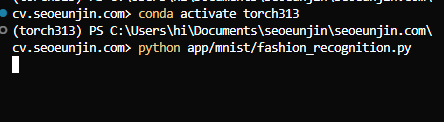
python app/mnist/fashion_recognition.py
Discover Ultralytics YOLO models | State-of-the-Art Computer Vision
Discover Ultralytics YOLO models | State-of-the-Art Computer Vision
Explore Ultralytics YOLO models - a state-of-the-art AI architecture designed for highly-accurate vision AI modeling. Ideal for businesses, academics, tech-users, and AI enthusiasts.
www.ultralytics.com


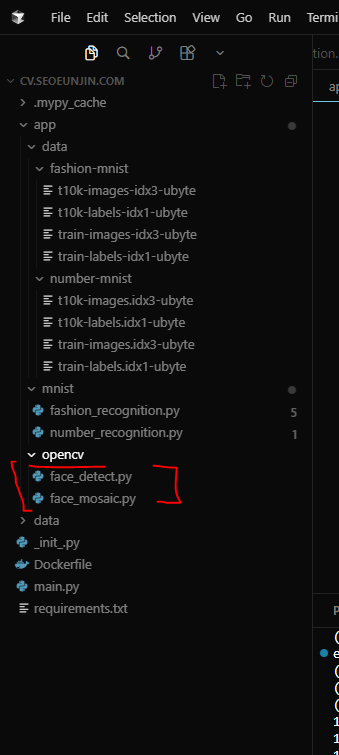
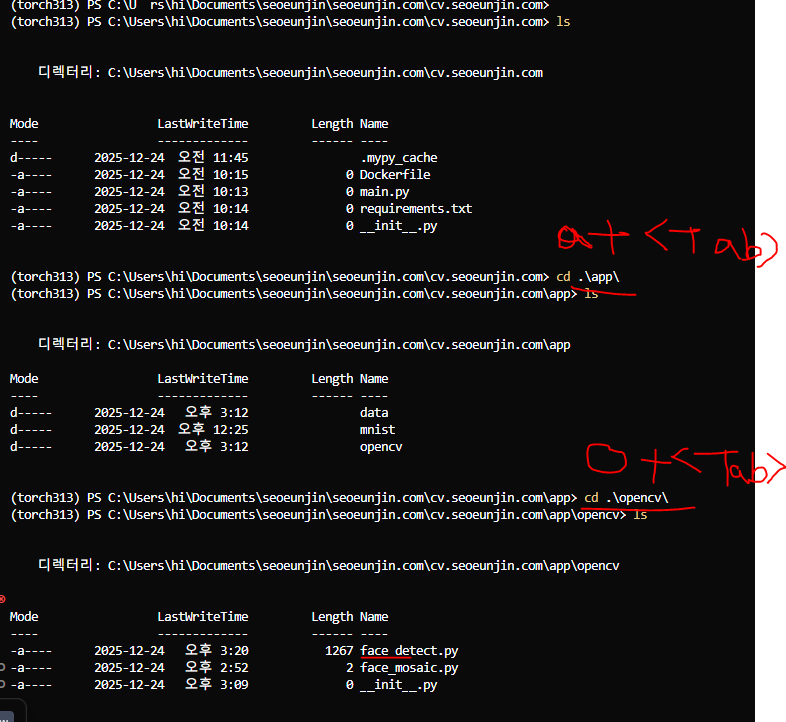
공파일 만들기
detect 파일이 자동으로 만들어짐
거기에 이 내용 넣고 프롬프트 넣기
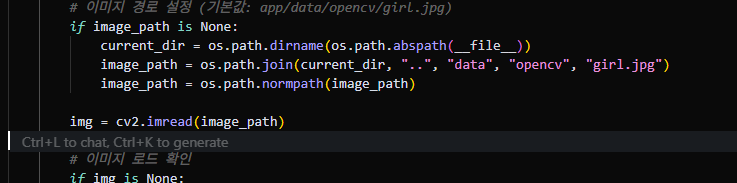
@face_detect.py (5-6) 이 파일의 경로를 이미지를 참조해서 너가 설정해줘

python face_detect.py
얼굴이 뽝 뜸!
얼굴 사진으로 되어있어야함
def mosaic(img, rect, size): (x1, y1, x2, y2) = rect w = x2 - x1 h = y2 - y1 i_rect = img[y1:y2, x1:x2] i_small = cv2.resize(i_rect, (size, size)) i_mos = cv2.resize(i_small, (w, h), interpolation=cv2.INTER_AREA) img2 = img.copy() img2[y1:y2, x1:x2] = i_mos return img2
-- 모자이크 추가
이미지 생성하기, 모자이크 하기
'Project ESG+AI > [삼정KPMG]ESG 데이터 활용 풀스텍 개발' 카테고리의 다른 글
| 65일차. (1) | 2026.01.16 |
|---|---|
| 49일차. (0) | 2025.12.19 |
| 47일차. 프로젝트에 맞춰서 AI 모델 선택하고 설정하기 (1) | 2025.12.18 |
| 46일차. (1) | 2025.12.16 |
| 45일차. (0) | 2025.12.15 |


